Sirat: Cinema That Gets Under The Skin
MAJOR SPOILERS ahead
We've all become experts at scrolling past things that should devastate us. Death, tragedies, war, it's all there between outfits of the day and selfies and whatever else we mindlessly swipe through. I've been doing it for years.
The other day I came across a skincare routine on Instagram, then swiped to torn up bodies being pulled out of the rubble. I kept scrolling.
We've become profoundly desensitized.
So when some form of content, a movie in this case, manages to cut through the numbness, that's not just entertainment anymore.
That's necessity.
There's a difference between a movie that shows you something and a movie that does something to you. The first you watch, maybe cry, and forget by dinner. The second gets under your skin and stays there, at least for a while.
Recently, I saw Oliver Laxe's Sirat.
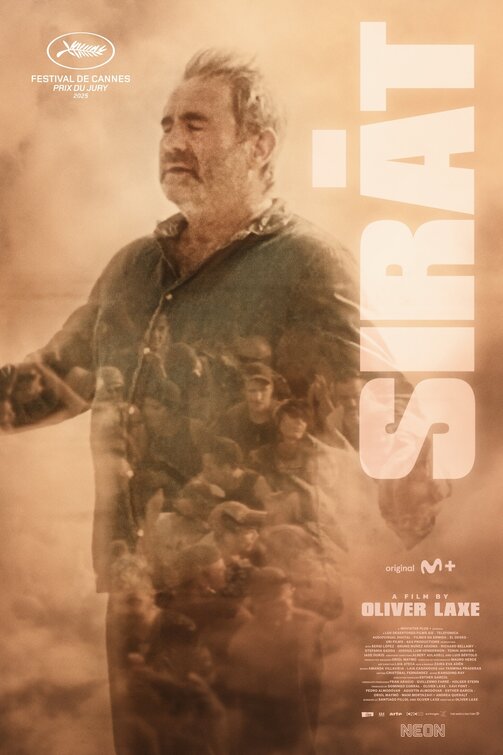
The premise is simple: a father and son travel into the rave scene in the Moroccan desert looking for their missing daughter. They fall in with a group of seemingly European ravers heading deeper into the wilderness, chasing one last rave. Radio broadcasts hint at a world falling apart. Nothing goes as planned.
There's a reading of the film that the director has spoken about. Finding god on the dance floor. Dancing your wounds away. Death as rebirth. The rave as spiritual transcendence. The Sirat, an Islamic term describing a bridge (a thin line) overlooking hell, as metaphor for the journey these characters undertake.
Maybe all that is there.
But it's not what I took home.
The orientalist undertones registered with me before anything else. White Europeans seeking meaning in the others' desert, trying to find themselves where natives are merely trying to survive, largely because of the west's interference in their countries. Even the title carries an orientalist touch.
Some moments made me cringe, a forced “Inshallah,” a scene where the raver watches Islamic pilgrimage rituals playing on a random TV. Part of me was annoyed by these bits, yet I kept watching as I got more and more absorbed by the audio-visual experience. As a whole, it was one hell of a ride. And I think that's worth sitting with rather than dismissing.
I'm sure that my viewing experience was greatly affected by what I brought with me, years of witnessing death and injustice, a growing numbness that I'm not proud of, a quiet dread of what is bottling up within me. These made me experience Sirat in a way that has nothing to do with spiritual rebirth, although I do love a rave every now and then.
Watching from a context where instability is a reality and an increasingly daunting one with no solution in sight, made the film hit hard.
Sirat didn't make me cry. It didn't manipulate me with swelling strings or sympathetic close-ups of suffering that tell you when to cry.
Instead, it delivered something close to a shock to my nervous system, an overwhelming sensory experience.
The film opens with speakers being set up in the desert. We hear it, the equipment being moved, the gritty rub of speakers against each other, the dust. The vibration enters your body before the story even starts. Then unnerving metallic saw-like sounds come and go, fused with hypnotic bass so deep you feel it in your chest.
In an early scene, the camera is mounted low on a car with the road sliding beneath it. A solid line runs diagonally in the frame, unbroken, and over it plays a Quran recitation, calm and soothing. Then the solid line begins to fragment into dashes, and as each gap opens up, the bass hits.
Already, the sound and image together are telling us this is going somewhere we're not ready for.
The desert amplifies this anticipation tension. The space is vast but it doesn't feel freeing, it feels suffocating. The more landscape opens up, the more trapped the characters become. Wide shots that should imply escape, suggest confinement instead.
Additionally, the framing puts you inside the characters' world. When the ravers' truck is pulling the family's car out of the stream, the camera places us inside the car being dragged. We hear the water rushing in before we fully see it. And we feel the car swaying. The boy perched on the driver's window frame and his dad gripping him, both anxiously hoping they make it to the other side.
We're not watching them from a safe distance, we are in the car with them. We are being dragged out of the water and pulled into a new world with them.
That's film form forcing us to experience the film events, not just watch them.
The cinematography, framing, music, sound design and other technical elements do much of the storytelling, engaging us on a deeper level and creating an intense, unsettling experience.
Most tragedy films run the same play: swelling strings, sympathetic close-ups, a clean emotional release. You cry, you feel like a good person for having felt something, you forget by dinner. Some critics call it poverty porn. The film did its job. Everyone moves on.
Sirat doesn't follow this formula and doesn't let you move on easily; it lingers with you at least for a few days. It's raw and unromanticized. No gratuitous sex scenes, no fetishizing or commercializing of the rave culture the way mainstream films usually do. Just bodies in a desert, chasing something… desperately.
Friends who watched it with me said they felt violated.
That's exactly what I appreciated. The film doesn't give you the comfort of a clear emotional release. It just… keeps… hitting.
Let me describe what I mean.
The group drives through the desert and up steep mountain roads, which feels ridiculously unnecessary. Then the first shock, the son in the car rolls off the edge and dies.
They keep going.
At some point, they realize they're lost in a vast, flat, endless stretch of nothing. So they decide to get high, put on music, and try to dissolve into the moment.
We watch them getting high. We almost feel it with them, we know that rising sensation. The dad is the one to focus on: we can see the drugs unlocking his bottled-up feelings; the grief he's been carrying starts to surface, we see it in his scrunching face. Then he slowly lifts his arms as he is about to release all his grief and pain, BUT just then, the lead actress, dancing, says “raise the volume… let's blow it up!” and she explodes, literally.
She was standing on a landmine.
Hard cut. No warning.
And then we watch the rest of them try to walk towards the rocks, one by one, trying not to step on a mine. We see their backs to the camera. The music shifts to this strange, game-like blurpy tone, disorienting, frightening.
Here, I'm not rooting for them to survive. I'm not sad. I'm suspended in dread, helplessly watching figures move towards possible death, not knowing which step will be their last. It feels like an existential state of being made visual, the imminent danger and the awful uncertainty we all live with, stretched into unbearable minutes.
I realized I was holding my breath and covering my ears.
That sequence, the high experience cut short by the explosion, the slow walk through the minefield, forces the viewer to plunge into shock and dread. Not tears. Not feel sorry from a distance. Not the usual jump scare.
It does something to the nervous system.
One gut-punch after another; no pause between them. Just when the dad is about to feel some relief, it's gone. There's no time to even grieve.
And for a lot of people on this side of the world, that's not a dramatic choice. That's just life. One misfortune after the other.
Through its use of the mentioned techniques, Sirat breaks the numbness that we've developed towards realities of death, war, loss and injustice. It jolts us and forces us to confront ourselves and feel something.
Sirat interrupts the conventional mainstream pattern by forcing a kind of confrontation instead of asking for empathy.
The one line that stayed with me:
“It will be horrible when the shock fades.”
That hit home. For years, I've watched injustice and death, near and far, and kept going. Business as usual; guilt always in the background. The guilt of living on casually, of knowing I'm complicit in a world that allows this. And I think somewhere deep down, this keeps reshaping me, for better or worse I genuinely don't know.
What the film left me with was exhaustion and dread more than sadness. The kind that feels like it has no specific address anymore, whether it is exhaustion from being caught up hustling in the rat race you never signed up for or from merely trying to survive. I know these are not the same and it's wrong to equate them. But the exhaustion feels related. And I'm just thinking out loud here.
Meshal Al Jaser's Saudi film Naga came to mind while thinking about all this.
It's a very different film, busier, denser, packed with motion. Where Sirat is sparse, Naga is frenetic and rich with details, both hypnotic in their own way. But what they share is a commitment to using film form to embody and transmit the experience, not merely show it. The framing, cinematography and editing do a lot of the storytelling, they tell you how to feel before the dialogue does. Alongside this, is a sound design that puts you inside the protagonist's panic rather than leaving you to observe from a safe distance.
What starts as something almost trivial, a curfew, expands into something consuming. You feel how quickly it spirals, how much sits underneath it, how something small on the surface carries a different weight from within.
Naga does something to you. The anxiety is not depicted, it's transmitted. You feel it in your own chest. A full body experience, a rollercoaster. And in that it quietly places you inside a reality that isn't always visible, one you need to experience in order to come close to understanding such inner struggles.
Back to Sirat.
I didn't connect with any of the characters. And I think that's what worked. They're not heroes; they're not positioned for our sympathy, they're just people, lost in a desert that offers nothing.
In my opinion, the absence of defined heroism made the film more powerful, not less.
There's something interesting about the protagonists being white, and yes, this is part of what makes the film problematic. The way I see it, it could force a western audience to not necessarily understand but to FEEL even if for a few moments what the other side of the world is used to: the randomness of death, a landscape that doesn't care about you, the absurdity of existence when survival isn't guaranteed, and foreign hands that keep it that way.
Sirat doesn't depict “the other's” struggles through explicit imagery or straightforward storytelling, casting/storyline; it rather conveys their mental realities through the form and the brutal, unpredictable turns of the story.
Compare such an approach to the growing number of films that portray non-western struggles in conventional, sensationalized ways. They raise awareness, sure. Audiences watch from their comfort zone, cry, go home and move on.
Sirat doesn't let you do that. It disturbs you and forces you to viscerally experience tough mental realities, which is a powerful approach in my opinion.
The final scene shows brown faces on top of a train. It reminded me of A Time to Kill, that closing argument where McConaughey walks the jury through horrific details of the rape, then says: “Now imagine she is white.” Sirat doesn't do that exactly. But watching white people get picked off in the desert by mines and indifference, then cutting to brown faces on a train, I found myself making that connection on the film's behalf: this is their life. Whether the director intended it or not is beside the point, that's just where my mind went. After all, what lingers… is a space for my readings of content through my own context.
Also on Substack